Αξιολογήσεις Ικαριακό Κέντρο: Εμπειρίες & Ιστορίες Μαθητών
Διαβάστε αυθεντικές αξιολογήσεις από μαθητές και επισκέπτες του Ικαριακού Κέντρου. Δείτε βίντεο και προσωπικές ιστορίες από τα μαθήματα ελληνικών και τις δράσεις μας στην Ικαρία. Οι αξιολογήσεις είναι γραμμένες στα Αγγλικά ή την γλώσσα των συγγραφέων τους.
Τοποθετήστε το ποντίκι σας στο πλαίσιο και κατεβείτε κάτω για να δείτε περισσότερα βίντεο
Laura
What can I say about my experience that nobody has already expressed? For me, when the time came to leave, I couldn’t remember what life was like anywhere else in the world. But that’s just it… in Ikaria, you are able to forget the world and focus on what it is that you came for… Each morning, I awoke to the soft sound of bells on sheep and to the crows of roosters. The sun bled in through my window lighting up the surrounding hills and making the sea sparkle. But back to the point of this text – you must want to know about the effectiveness of the course? I, personally, have been living in Athens for the past year and have dabbled in language courses. This course helped me to gel together my grammar notions. We learned a lot, but in a way that was digestible. We read texts, which were accompanied by MP3 players to be able to hear Greek. We learned a lot of new vocabulary and each class was tailored to our personal grammar needs. Outside of class, we built friendships—we experienced things together that I will never be able to forget. I can definitely say that I feel a great improvement in my Greek language skills after completing this course. I would and will continue lessons with the Ikarian Centre in the future (as many of my classmates have already done).
Laura WeikelWhat can I say about my experience that nobody has already expressed? For me, when the time came to leave, I couldn’t remember what life was like anywhere else in the world. But that’s just it… in Ikaria, you are able to forget the world and focus on what it is that you came for… Each morning, I awoke to the soft sound of bells on sheep and to the crows of roosters. The sun bled in through my window lighting up the surrounding hills and making the sea sparkle. But back to the point of this text – you must want to know about the effectiveness of the course? I, personally, have been living in Athens for the past year and have dabbled in language courses. This course helped me to gel together my grammar notions. We learned a lot, but in a way that was digestible. We read texts, which were accompanied by MP3 players to be able to hear Greek. We learned a lot of new vocabulary and each class was tailored to our personal grammar needs. Outside of class, we built friendships—we experienced things together that I will never be able to forget. I can definitely say that I feel a great improvement in my Greek language skills after completing this course. I would and will continue lessons with the Ikarian Centre in the future (as many of my classmates have already done).
Laura WeikelIl mio corso di greco a Salonicco
Cari amici che avete voglia di andare all' Ikarian Centre a Salonicco, andateci!! Ho frequentato un corso di due settimane (agosto '11) ed e' stata un'esperienza assolutamente positiva. Dal punto di vista linguistico l'insegnamento e' improntato molto sulla parte orale, conversazioni, dialoghi, canzoni, film (al cinema) senza pero' trascurare la parte scritta e grammaticale. Abbiamo inoltre incontrato persone, greche e straniere, che vivono e lavorano a Salonicco, abbiamo fatto giri per la citta' con chi ci ha raccontato aneddoti e storie in modo molto amichevole e per niente noioso, siamo andati sul Monte Olimpo. Se verrete qui a Salonicco avrete anche la possibilita' di girare, anche quando siete per conto vostro, una citta' interssante dal punto di vista storico e molto vivace, che la sera vi offre la possibilita' di vivere serate tra la gente del posto, cosa che considero tra le piu' interessanti quando si viaggia. Silvia
Course evalutation
I attended a two-week Greek course in Thessaloniki and I must say that I am very satisfied.
I had studied the language two hours a week for only 8 months before I arrived in Greece and I wasn't really able to speak or understand properly. Now at the end of the course I can communicate much better with the Greeks and also my comprehension has improved a lot.
I was one of the students with less vocabulary and grammar and that is why I could learn so much during my stay here. The course was supposed to last for 40 hours, but actually our teacher spent much more time with us, thus we could practice also in the evenings and during the weekend. We all got along well and that is why we often spent our leisure time together. I liked how the course was organised, with a good mixture of grammar, exercises, listening comprehension and conversation also with Greek people, who were invited to come and talk to us. And if we had any problem or question, we could really feel free to ask.
I also liked Thessaloniki. I walked many hours to get an impression of the city, to visit churches and go to the museums. As the course took place in August, we also went to the beaches outside the city, because in the centre it is forbidden to swim.
Monica
Studying Greek at Ikarian Centre
I can fully recommend studying Greek at the Ikarian Centre. Ikaria is a great place to spend time. The centre is in a rural location in the mountains, not too far from the town, Evdilos, and the seaside. The scenery is amazing and there is lots to see on the island – several excursions were organised. The food is also very good.
I found the courses very constructive. The courses at the Ikarian Centre are very much focused on on both oral and written production. Lessons partly involved the learning and revising of grammar, but were mainly based on texts. We would first learn the necessary vocabulary for the topic in question and then listen to the text on headphones and answer questions. The next lesson would then involve speaking freely about the topic, or writing a text.
I had been learning Greek for two years for work purposes so had a good grounding in grammar and (passive) vocabulary. The main benefit, for me, of the language course was that the organisation of the courses allowed me to practise my Greek and gain confidence in both speaking and writing Greek. Owing to the location, it was also easy to speak Greek outside the centre, as the island has relatively few tourists.
You will also find the staff at the Ikarian Centre very welcoming. I would recommend that students stay at the centre to avoid commuting, as the accommodation is highly satisfactory.Andrea
I have been studying modern greek for almost 4 years at the Hellenic centre in London- www.helleniccentre.org/greekcourses.htm. I enjoyed this so much, I wanted to advance my greek by doing a more intensive course in Greece for two weeks- at the same time getting away from it all on what was reputed to be a left wing, slow-to-respond island.
The Ikarian Centre was great. In a most beautiful location with extraordinary tranquility, but at the same time lots of daily excitement from negotiating the narrow, dirt, switchback roads to and from the Centre, along the mountain, meeting a few goats or a local farmer who had decided to have a chat to his neighbour in the middle of the road. Fortunately one of our group volunteered to drive for our daily outings- thanks so much to the fab. Tim. The local taverna- I Plaka- became a favourite though other tavernas for lunch or dinner were easy to find, cheap, delicious and allowed us to practice our greek. Anna’s was truly sensational and such a warm welcome. The local population were consistently helpful and encouraging. The sea was not far, we sampled lots of nice, and a few great, beaches – gorgeous water.What about the actual greek course? The lessons were excellent- we had three really good teachers who shared out the 3-5 hour sessions. We also had discussions about greek politics, the health system- two of us were doctors- a cooking lesson, dancing with a local dance school- who very kindly accommodated us, a hike down a gorge(see photo) singing at sunset with the most fabulous view(see photo). It was all really fun, in a fantastic setting, with nice people and…my greek improved a lot – though there is still great scope! I was really sad to leave.
Photos from Andrea:
www.facebook.com/media/set/?set=a.10150233503432459.344230.170201777458&l=e004d8279aI have been studying modern greek for almost 4 years at the Hellenic centre in London- www.helleniccentre.org/greekcourses.htm. I enjoyed this so much, I wanted to advance my greek by doing a more intensive course in Greece for two weeks- at the same time getting away from it all on what was reputed to be a left wing, slow-to-respond island.
The Ikarian Centre was great. In a most beautiful location with extraordinary tranquility, but at the same time lots of daily excitement from negotiating the narrow, dirt, switchback roads to and from the Centre, along the mountain, meeting a few goats or a local farmer who had decided to have a chat to his neighbour in the middle of the road. Fortunately one of our group volunteered to drive for our daily outings- thanks so much to the fab. Tim. The local taverna- I Plaka- became a favourite though other tavernas for lunch or dinner were easy to find, cheap, delicious and allowed us to practice our greek. Anna’s was truly sensational and such a warm welcome. The local population were consistently helpful and encouraging. The sea was not far, we sampled lots of nice, and a few great, beaches – gorgeous water.What about the actual greek course? The lessons were excellent- we had three really good teachers who shared out the 3-5 hour sessions. We also had discussions about greek politics, the health system- two of us were doctors- a cooking lesson, dancing with a local dance school- who very kindly accommodated us, a hike down a gorge(see photo) singing at sunset with the most fabulous view(see photo). It was all really fun, in a fantastic setting, with nice people and…my greek improved a lot – though there is still great scope! I was really sad to leave.
Photos from Andrea:
www.facebook.com/media/set/?set=a.10150233503432459.344230.170201777458&l=e004d8279aFirst week of classes
July 16, 2006
We’ve finished the first 5 days of classes. As someone who is not facile with languages, not to mention starting one at my age, I must say that the methods they use here really make learning Greek possible, if you work at it. The hard part is continuing it when you leave, but when you’re here, it’s pretty much an immersion experience. We have about 10 students and 2 teachers. This allows for a lot of attention and help, and also some interaction. The teachers use pictures, projects, cd’s, plays, lectures, slides, singing, dancing, cooking, conversations, and very little of any textbooks. Sandra & I have talked with the Spaniards here who’ve taken classes at other schools in Greece, and they say this is far and away the best. The other schools seem very much by-the-book operations, literally, with the result that if you don’t have that learning style, you are in trouble.
We are in class for 2.5 hours each morning, then a long break, for doing homework, shopping, and resting, till around 7, then 2.5 more hours of class. The classes are divided by level in the morning, and then we are all together in the afternoon class. Two days ago we read fairy tales in small groups, then re-told them to the class. Yesterday, we made up our own fairy tales, using small pictures of “fairy tale objects” (sword, dragon, forest, princess, witch, etc.). Each group got the same pictures, but each member had some randomly assigned, then we went around in a circle, adding a picture and continuing the story. You can see how many different things are involved here: vocabulary, comprehension of others’ speech, conversation for clarification, and speaking yourself, for starters. Way more fun and useful than reading a text and anwering written questions on a piece of paper. The school is worth the money it costs to come here, believe me.
Two nights ago we all cooked together, some Ikarian dishes and others, as our evening project, had a short dance lesson taught again by me, then sat down for another long dinner outside on the upper patio. There we had a discussion on what a “party pooper” is in 3 languages. You ought to try to explain some of these things in Greek sometime!
[Note from Sandra:
ParteePOOpears!!
There is no good , compact word in Greek for “party poopers”. When David, another student, one of our Greek teachers and I left a wedding party quite early (1:30) the Sunday we arrived, I explained to the teacher that “sta Anglikä” (English) we use the term “party poopers” to describe what we surely were just then! Evgenia, (the teacher) was really entranced with the term and repeated it many times with her unique Greek pronunciation which cracked us up completely. It ends up sounding more like one word, the way I wrote it above as a title, with slightly rolled Greek “r’s” and the last syllable like “pears”.
“ParteePOOPears” became the favorite funny phrase of the school for the next few days. Evgenia said that sadly, Greek did not have a such a good, colorful term to describe someone who was not that interested in remaining for an extended celebration. The night of the wedding, the four of us had definitely been the class ” POOpears”!
A few days later at the school, David and I were decifering some Greek from a CD that explained some of the traditions of Carvaval in the northern Greek town of Kastoria. We came across a lovely phase in Greek: “The city of Kastoria has its own way of bringing spring back from the heart of winter”. “Ah!” I lamented to our Greek teacher Evgenia who happened to be passing by as we GOT the translation, ‘the HEART of winter!’! That is really beautiful!! In English we have to say, in the DEAD of winter! We really do not have an expression that is as beautifully descriptive as this!”
Eugenia thought for a moment and then said in Greek, “Yes! But you DO have ‘ParteePOOPears!’ We don’t have THAT!!
BACK TO DAVID]
Other nights we go out to dinner after the late class, arriving at the taverna around 10 or 10:30. More conversation (in Greek), more mistakes, but communication is also achieved, and the practice is what we all need. The food, especially at the taverna in Pera Arethusa, is really delicious–it’s like Greek tapas–and the prices here are not city prices at all, shockingly low for an American.
Yesterday we went to a different beach and spent the whole day there. I hardly ever do this, so it’s a treat more me, not that I get to swim (I can’t) but just to relax. We walked along the sea rocks to another, smaller beach, above which was a taverna with a terrifci view. This is common on the islands, and makes for a complete experience. After three hours of eating and talking we walked back on the high road, because the tide had come in. there we met a man born there but who had lived in Chicago. He spoke Spanish with a Mexican accent and told us about his restaurant in Chicago where he talked once with Micahel Jordan. We also spoke a little with his wife, up the road. Many Ikariotes have spent time in the United States, earning money, coming back for the summer, then moving back when they older. But we’ve also heard of people returning to build big, American-style homes completely out of place on this island. It seems that the bigger is better syndrome is not isolated to just the US.
This brings up another subject, the way the Greeks treat the environment. We met a photographer who told us about the Ikarians, throwing their old furniture, car parts, etc. right on the beach. This includes the local hospital (ewhose CEO denied it), and consists of old bedframes, needles, toxic waste, etc. There’s a lighthouse a bit of the way out whose light runs on a battery, similar to a car’s. Well, when the battery dies, the Coast Guard goes out there, replaces the battery, and throws the old one into the sea. Recreational divers near there see a sea floor littered with old batteries, which of course corrode and release toxins and metals into the water; these work their way up the food chain, etc. There’s a lot of asbestos int he buildings, and when workers are revoving it, they just tear it down and toss it. The dust gets everywhere and they don’t wear masks or protective clothing. Kids play around the work area. The photographer is having an exhibition here at the school with some of his photographs about these subjects. He lives here near Evdilos.
On a slightly lighter note, the Greek pluming system leaves much to be desired. We’ve had several installments of “The Turd That Would Not Die,” and you take a shower hoping all the water will go down the drain. On the other hand it is possible to have running water, even hot water (solar-heated), so it’s actually very convenient, and it mostly makes for a good story.
If you want to see some pictures of Ikaria that I took the last two years, go to my flickr photostream at
http://flickr.com/photos/bilidesd/sets
and click on either of the Ikaria sets. I won’t be uploading this year’s photos till I return home; the connection’s too slow.
About 8 new students arrived this morning (Sunday), from Germany, the US, Russia and Spain. They’re all worn out, but we’ll be getting together tonight for a dance lesson with me trying once again to do it in Greek. There’s a paniyiri in Arethousa tomorrow night. We can walk to it, have a very late meal, and then try not be parteePOOpears again! Talk to you in a few days…
First day in Ikaria
July 10, 2006
Prior to coming to this lovely island for our third straight summer, we spent a day in Athens of the sort that you can only do when you are on vacation. That is, after leaving our hotel, we spent several hours looking for a CD with the violinist Yiannis Zevgolis. The instrument museum shop was closed, so we went to two very loud CD stores near Omonia Square, and still didn’t find it. Escaping the hellish traffic and faseria of Omonia, we ducked into a…Starbucks!, not that we would ever patronize Starbucks, but it was the nearest place that we could be quiet and not have to deal with cigarette smoke. It is ironic to me that the Greeks, who love their children dearly, are slowly killing them with secondhand smoke, when they’re not killing themselves first.
OK, then we had the rest of the day to catch our ferry. When else can I say that I’m just going to do nothing for 6 hours until I leave? From experience, we had decided that the only way to go overnight (or on any long ferry ride) was to splurge on a cabin, again because it ws quiet, and the air was pretty much smoke-free. (Although there are non-smoking sections on the boat, they are open to the other, smoking sections, so they’re pretty much useless. This is similar to the non-smoking cars on trains, which have an upper, non-smoking level on a car above a smoking level! Of course, all the smoke rises to the second level. Maybe someday this will change.
Anyway, the cabin was heaven, and the ferry ride was uneventful. If you haven’t taken a ferry boat, it is difficult to describe the feeling as one waits for the enormous cargo door to open slowly in front of you, revealing your new island destination.
Mihali, the director of the Ikarian Center where we study Greek, picked us up. We caught up on some news and quickly arrived in Arethusa. The school setting is quite beautiful, with mountains across the valley from the cabins, and the Aegean with Hios and Turkey in sight on the horizon. The cicadas produce the best white noise, and the quiet is otherwise deafening. It is difficult to imagine a better setting for studying Greek intensely. In fact, with this year’s additon of a working kitchen, many groups could use this as an ideal retreat, if the transportation could be afforded. It would probably work better for Europeans.
We were soon joined by the other students for this two-week course, some Spaniards and a fellow from France. Already here from last week were a German woman we’d met two years ago, an Austrian woman, and an American, Emily, who is going to Yale and already speaks 5 languages at the age of 20 or so. In other words, everyone wipes the floor with me in tha language department. To be fair to myself, I am definitely better than I was when I first started, and I can understand what’s going on much better as long as people pretend I’m about 4 years old. Seriously, though, I do get by.
Once we unpacked it was off to the mountains for a hike. They don’t waste time here, although they understand the meaning of taking your time. We drove to Armenistis, on the west end of the north side of the island and took about a 3-hour hike up into the mountains. Ikaria is greener than many islands, and still has running water from streams and springs at this time of year. We passed many lovely pools once we got some elevation. If I ever come here for a longer time, I would like to hike around the island. They’ve got a system of paths in place that makes it pretty easy.
We hiked back down to the beach, where some cooled off in the crystal clear and impossible blue of the Aegean. Then, we had to have our meal, of course. This consists of seemingly countless dishes of a wide variety of foods over the next several hours. There were 12 in our parea, so we had a large sampling, much drinking of excellent retsina, and a lot of fun. These kinds of meals are de rigeuer in Greece; I wish Americans would get this concept; you don’t really have to DO anything.
We drove back to Arethusa and rested for an hour. Then I taught everyone the main dance of the island, Ikariotikos, because in one hour we were going to a wedding in the next village (this is not a typical day, in case you are wondering, but as long as there are fun times to be had, we take advantage of them). I can teach no sweat in English, but it was a challenge in Greek, as I had to ask how to say “lift your heel” and other esoteric phrases sutiable for dancing and not much else. Still, everyone pretty much got it, and I was glad to contribute in this way.
Once we finally made it to the wedding, nearly two hours after it was supposed to start (this is typical), some us stayed in the plaza restaurant to watch some of the World Cup final (being as my mother’s family is from Naples, I of course was rooting for Italy, which later won, amzingly enough), and then we went to the plateia and sat down with about 400 other people (the entire village comes to these weddings), and were served food over the next several hours (don’t go to Greece if you want to lose weight).
THe band was only so-so in my opinion, but after a desultory set of bouzoukia, they finally pulled out a violin and started Ikariotikos. This got the bridal party up dancing (in all the paniyiri we ‘ve gone to here, no one starts dancing until they play this dance). Things continued with other island tunes, and when they played Ikariotikos again, my fellow students and I danced and had a good time. Sandra & I also danced a waltz and a polka. These European dances are required for any social occasion where there is dancing, and included the “Fox” and a tango. We finally left and went home around 1:30, marveling on a terrfic and very full first day.
Source: First day in Ikaria | Lion Views
Αξιολογήσεις από το Google
Follow this link
or scan the Following QR code to leave your review in google

Η Άννα στην Washington Post
Μια μαθήτριά μας περιγράφει την εμπειρία της από την Ικαρία
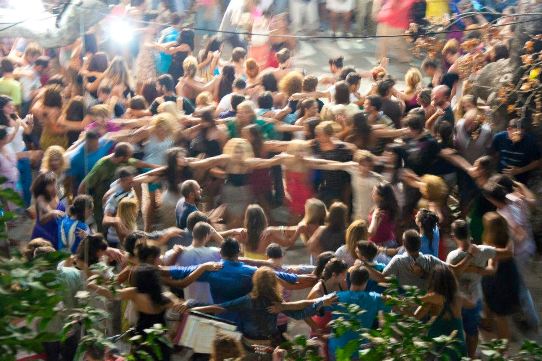

Lessons in language and life on the Greek island of Ikaria
By Anna Hestler
January 31, 2013
At a mini-market on the Greek island of Ikaria, I study the labels on various items, trying to decipher their meaning. It’s been three days since I left my Greek husband back in New York and dove headfirst into a local language immersion course. I’m feeling a tad out of my depth.